Delta Brainwaves: Where Deep Sleep Meets Recovery
Earthly Alchemy · 19 August 2026 · 12 min read
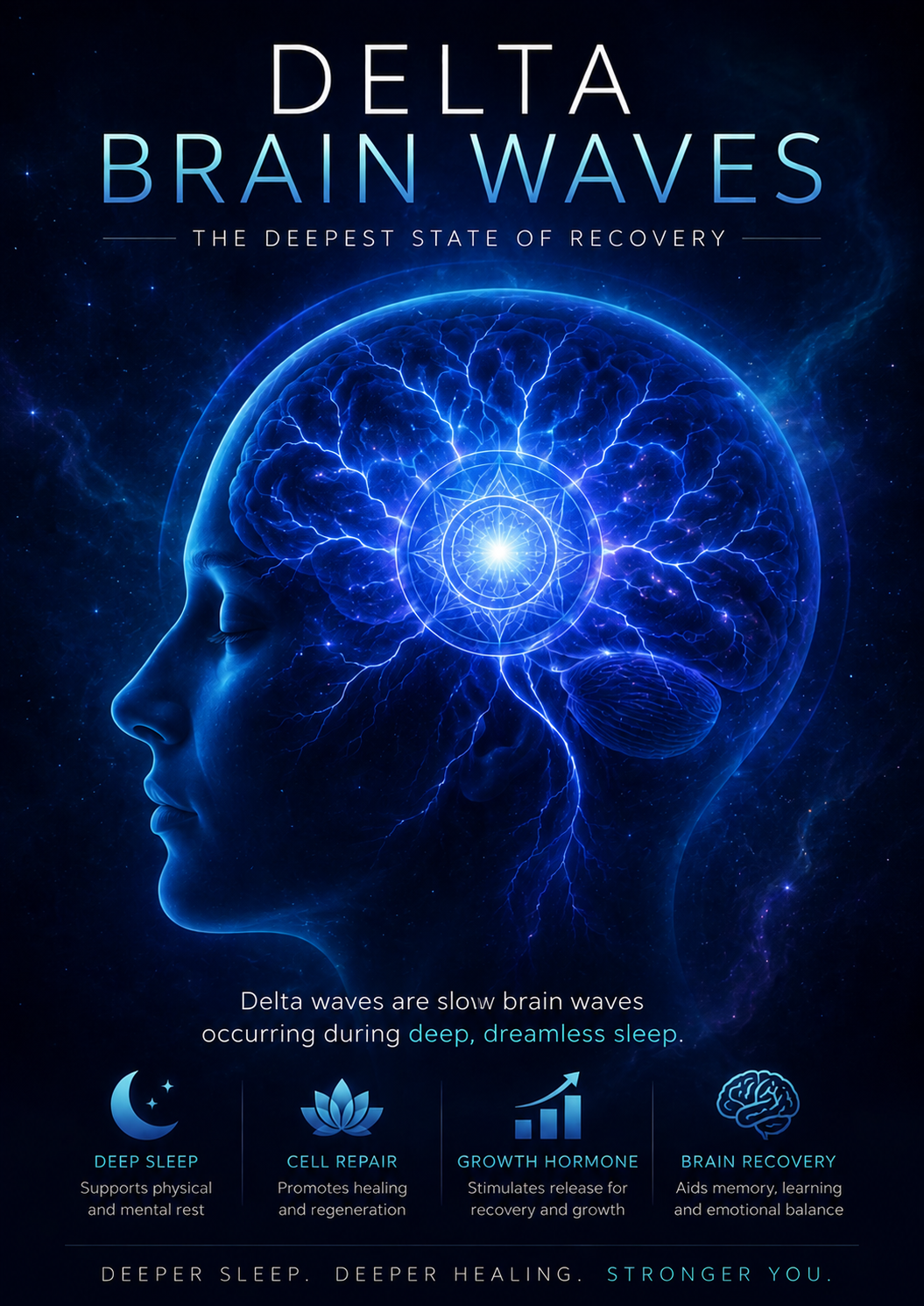
If you train, you may already track the things you can measure, training load, volume, nutrition, heart rate variability, split times, strength numbers and other indicators of performance and recovery.
Yet there is one critical window in which much of the body's repair and adaptation takes place, and it is often overlooked.
Sleep.
Sleep is not simply the gap between training sessions. It is the time when your body gets to work recovering from the demands you have placed on it and adapting to the training you have completed.
Within sleep, there is one particular state that carries a remarkable amount of this restorative work. It has a name, a measurable frequency and a range of specific roles in the recovery process.
It is called delta.
What Are Delta Brainwaves?
Your brain is electrical. Networks of neurons communicate through electrical activity, and these rhythms can be measured in cycles per second, or hertz.
These patterns are grouped into different frequency bands, and each band tends to appear more prominently during different states of consciousness and sleep.
Beta activity is associated with alertness, concentration and problem solving. Alpha activity tends to become more prominent when you are calm, relaxed and inwardly focused. Theta activity is associated with drowsiness, deep relaxation, meditation and dreaming sleep.
Then there is delta.
Delta brainwaves sit within the 0.5 to 4 Hz range. They are slow and unusually high in amplitude, meaning that large populations of neurons are firing together in long, synchronised waves rather than rapidly and independently.
On an EEG, delta activity appears as broad, rolling waves rather than the tighter ripples associated with faster brainwave frequencies.
Delta is associated with the deepest stages of non-REM sleep, particularly slow-wave sleep.
There is one common statement about delta that is worth clearing up. You will often see it described as the slowest brainwave. It is not. There are slower forms of brain activity below the delta range, including very slow oscillations that can unfold over many seconds.
What makes delta important is that it is a dominant rhythm of the brain's deepest restorative state and is closely associated with many of the physical and neurological processes that take place during deep sleep.
The brain operates at many different speeds throughout the night. It moves through different rhythms and states in cycles, and each one has a role to play.
When you reach deep, delta-rich sleep, some of the body's most important recovery processes get underway.
What Happens in the Brain During Delta Sleep?
The Glymphatic System: Your Brain's Overnight Clean-Up Crew
Every waking hour of thinking, training, working and dealing with stress leaves metabolic waste within the brain.
Fortunately, the brain has its own dedicated clearance system. It is called the glymphatic system.
During deep sleep, fluid moves through the spaces surrounding the brain's blood vessels, helping to clear waste products from brain tissue. Among the substances involved are protein fragments associated with long-term cognitive decline.
This process occurs during deep, slow-wave delta sleep.
While you are asleep, your brain is actively working to restore its internal environment and prepare itself for another day.
This is one of the reasons delta sleep matters so much. You do not simply wake up with a body that has been training, working and moving all day. You wake up with a brain that has been doing the same.
Deep, delta sleep gives your brain the opportunity to carry out its own overnight clean-up process.
When deep sleep is repeatedly disrupted or shortened, some of this restorative work can be compromised. This is one reason why the quality and architecture of your sleep can be just as important as the number of hours you spend in bed.
Growth Hormone and Physical Repair
If you are an athlete, you'd be aware of the importance of growth hormone. What you may not realise is how closely its natural release is connected with delta sleep.
One of the largest growth hormone pulses in a 24-hour period occurs during the first major period of deep, slow-wave delta sleep, usually within the first couple of hours after falling asleep.
Growth hormone plays important roles in tissue repair, muscle recovery, bone maintenance, and other processes involved in growth and regeneration.
For anyone training hard, this is hugely important.
Think about what training actually does. You stress the muscles, challenge the nervous system and create a demand for adaptation. Training provides the stimulus, but the adaptation does not happen simply because you completed the session.
Your body needs time and the right physiological conditions to respond to that stimulus.
The workout is the stimulus. Delta sleep is where much of the recovery and adaptation takes place.
This is why consistently sacrificing sleep to squeeze in more training can become counterproductive. You can continue adding training stress, but if you continually reduce the recovery window, your body has less opportunity to respond to that stress.
Memory Consolidation and Learning New Skills
Sleep is not only about physical recovery. Your brain is also processing and organising what happened during the day.
Sleep plays an important role in memory consolidation, helping newly acquired information become more stable and accessible.
This includes movement and physical skills. Think about learning a new technique, making a technical correction or changing a movement pattern. You practise it while you are awake. You repeat it, refine it and reinforce it. The brain continues working with that information while you sleep.
Delta sleep plays an important role in the complex processes through which the brain consolidates newly learned information and movement patterns.
This helps explain something athletes and coaches have experienced countless times. You can work on a movement one day, sleep on it, and find that the movement feels noticeably more natural the next day.
You did not consciously practise it overnight. Your brain continued processing what you had learned.
You learn while you are awake, but sleep helps your brain consolidate what you have learned.
For athletes, that means sleep is not simply helping you recover from yesterday's training. It is also helping prepare your brain for tomorrow's performance.
Immune Function: Sleep is Medicine
There is another reason delta sleep matters enormously to athletes: the immune system.
Deep, delta sleep supports immune function on multiple levels. It helps regulate immune signalling and inflammatory processes, providing another important layer of recovery.
Athletes often discover the relationship between training load, sleep and immunity the hard way.
A heavy training block combined with consistently poor sleep can leave you feeling run down. The cold that will not shift, the niggle that lingers, the recovery that seems slower than it should be, or the plateau that no amount of extra work seems to fix can all be signs that your body needs more recovery.
Sometimes the answer is not another supplement, another recovery gadget or another training session. Sometimes your body needs something much more basic.
Delta Sleep.
Sleep is not a substitute for medical care, but it is one of the most powerful recovery tools your body already has.
Unlike many performance interventions, it is available to you every single night.
Delta Sleep Changes as We Age
Here is something that becomes particularly interesting as we get older.
Delta sleep changes across the lifespan. Deep, slow-wave delta sleep is abundant during childhood and adolescence, but it gradually declines from early adulthood onwards and continues to change through midlife and beyond.
You might spend the same number of hours in bed at 45 that you did at 25, but the architecture inside those hours is not necessarily the same.
There can be less time spent in the deepest stages of sleep, more fragmentation and more brief awakenings that you may not even remember.
This helps explain something many athletes experience as they get older. Recovery can start to feel different. You may be training smarter. Your nutrition may be better. Your strength and conditioning may be better. You may understand your body better than you did 20 years ago. Yet you can still find that recovering from a hard session takes longer.
Deep delta sleep becomes something worth protecting.
For athletes who want to continue performing well through their 40s, 50s and beyond, sleep deserves the same attention we give to training and nutrition.
What Can Interfere with Deep Delta Sleep?
There are many things in modern life that can interfere with our ability to reach and maintain deep, restorative sleep.
Alcohol
Alcohol may make you feel sleepy and can shorten the time it takes to fall asleep, but it can interfere with normal sleep architecture and fragment sleep later in the night.
It is a sedative, not a sleep aid.
Caffeine
Caffeine has a half-life of several hours, which means that the coffee you had in the afternoon can still be circulating in your system at bedtime. Even if you feel as though you can fall asleep normally, caffeine can interfere with the quality and depth of your sleep.
Eating Late
Eating a large meal close to bedtime can keep digestion active when your body should be winding down. Your body needs to transition into its nighttime state, including the natural reduction in core temperature that accompanies sleep.
Evening Stimulation
Hard training late at night, news, screens, endless scrolling, work and difficult conversations can all leave your nervous system highly activated when it is time to go to sleep.
Irregular Sleep and Wake Times
Your body runs on rhythm. Going to bed and waking at dramatically different times from one day to the next can make it harder for your circadian system to establish a consistent sleep pattern.
Light at Night
Bright light in the evening, particularly blue-heavy light from screens and artificial lighting, can interfere with the natural rise in melatonin that helps prepare the body for sleep.
Chronic Stress
This is a big one. When your nervous system is constantly operating in a state of vigilance, switching off is not always easy.
Deep delta sleep requires your body to feel safe enough to let go. It's the sleep state you feel the most vulnerable in because it's the hardest one to wake up from.
How Can You Protect Your Delta Sleep?
Protecting delta sleep comes down to a series of small, repeatable choices that tell your body that the day is genuinely finished and it is time to recover.
1. Get Outside in Natural Light After Waking
Morning light helps anchor your circadian rhythm and sets the timing of your sleep-wake cycle for the following night. Getting outside as soon as you rise, allowing your eyes to receive natural daylight is one of the simplest ways to support your body clock.
2. Reduce Bright Light After Sunset
Dim the lights, use warmer lighting and reduce unnecessary screen exposure. Let your environment begin to resemble the natural transition from day into night.
3. Make Your Bedroom a Sleep Sanctuary
Keep your bedroom cool, dark and quiet. Remove unnecessary distractions and electronics where possible. Your bedroom should send one clear message to your brain: this is where we sleep.
4. Give Your Body Time to Finish Digesting
If eating late affects your sleep, experiment with finishing your evening meal earlier and allowing your body time to settle before bed.
5. Be Mindful of Caffeine and Alcohol
If you are serious about sleep, stop caffeine earlier in the day, ideally before midday. Similarly, do not rely on alcohol as a way to wind down at night.
6. Reduce Evening Stimulation
Give your nervous system a chance to shift gears. Create a transition between the demands of the day and the stillness of the night.
7. Keep Your Sleep and Wake Times Consistent
Your body loves rhythm. A reasonably consistent sleep and wake window gives your circadian system a predictable pattern to work with.
8. Put the Phone Down
This sounds ridiculously simple, but it can make a significant difference. Give yourself some time before bed when you are not consuming information, responding to messages or endlessly scrolling.
Your brain has spent all day processing information. Give it an opportunity to stop.
9. Train, but Respect the Timing
Exercise is one of the best things you can do for sleep, but pay attention to how your body responds to very intense training late at night. Your nervous system is still humming hours later. Learn what works for your body and ideally train earlier in the day.
10. Create a Transition into Sleep
Gentle stretching, easy mobility, slow breathing, reading or another quiet routine can help create a bridge between doing and resting. The goal is to give your nervous system a clear signal that the day is coming to an end.
11. Your Sleep Soundly Delta Soundscape ™ Audio
This is where our own interest in delta brainwaves and sleep comes in.
Sound can become part of a consistent nighttime ritual, providing your brain with a familiar auditory environment as you transition from wakefulness towards sleep.
That is exactly why we created the Sleep Soundly Delta Soundscape™ Journey.
Returning to the Wisdom of Rest
We live in a culture obsessed with output. We are encouraged to train harder, optimise more, track everything and squeeze another session into the week. Rest is often framed as something we earn once the work is finished, or worse, something we sacrifice to prove that we are serious.
Your biology does not work that way. Your brain operates at many different speeds, and each has a purpose. The faster rhythms associated with focus and alertness are essential when you are awake and performing. The slower rhythms of delta sleep are equally important when it is time to recover.
During deep, delta-rich sleep, your brain and body are carrying out some of the most important work of the entire 24-hour cycle.
Waste is cleared. Tissue is repaired. Growth hormone is released. Skills are consolidated. Immune function is supported. Your nervous system gets the opportunity to recover.
Recovery is not what happens after training. Recovery is part of training.
You train to create the stimulus. You sleep to give your body and brain the opportunity to recover and adapt. Then you wake up and do it again.
Train. Sleep. Adapt. Repeat.
Sleep Soundly Delta Soundscape Journey™
Our fascination with deep sleep and delta brainwave activity is what led us to create Sleep Soundly.
The Sleep Soundly Delta Soundscape™ Journey is a six-week experience designed to support your transition into deeper sleep through six carefully created audio soundscapes.
You listen to one soundscape for a week before progressing to the next, moving through three stages:
Ambient Sleep → Deep Sleep → Deep Delta Sleep
Alongside the six audios is the 6-Week Deep Sleep Reset Guide, which provides practical strategies and education to help you create the conditions for better sleep.
Sleep Soundly is about creating a consistent nightly ritual and giving your brain another tool to support the transition into delta sleep.
Your recovery deserves the same attention as your training.
Train. Sleep. Adapt. Repeat.
Keep reading
- Sleep Is the Recovery Tool You're Not Training
Every athlete is chasing an edge. Better programming, better nutrition, better recovery tools. But one recovery tool is available to every athlete, every night, and it is often overlooked: sleep.