Sleep Is the Recovery Tool You're Not Training
Earthly Alchemy · 1 September 2026 · 10 min read
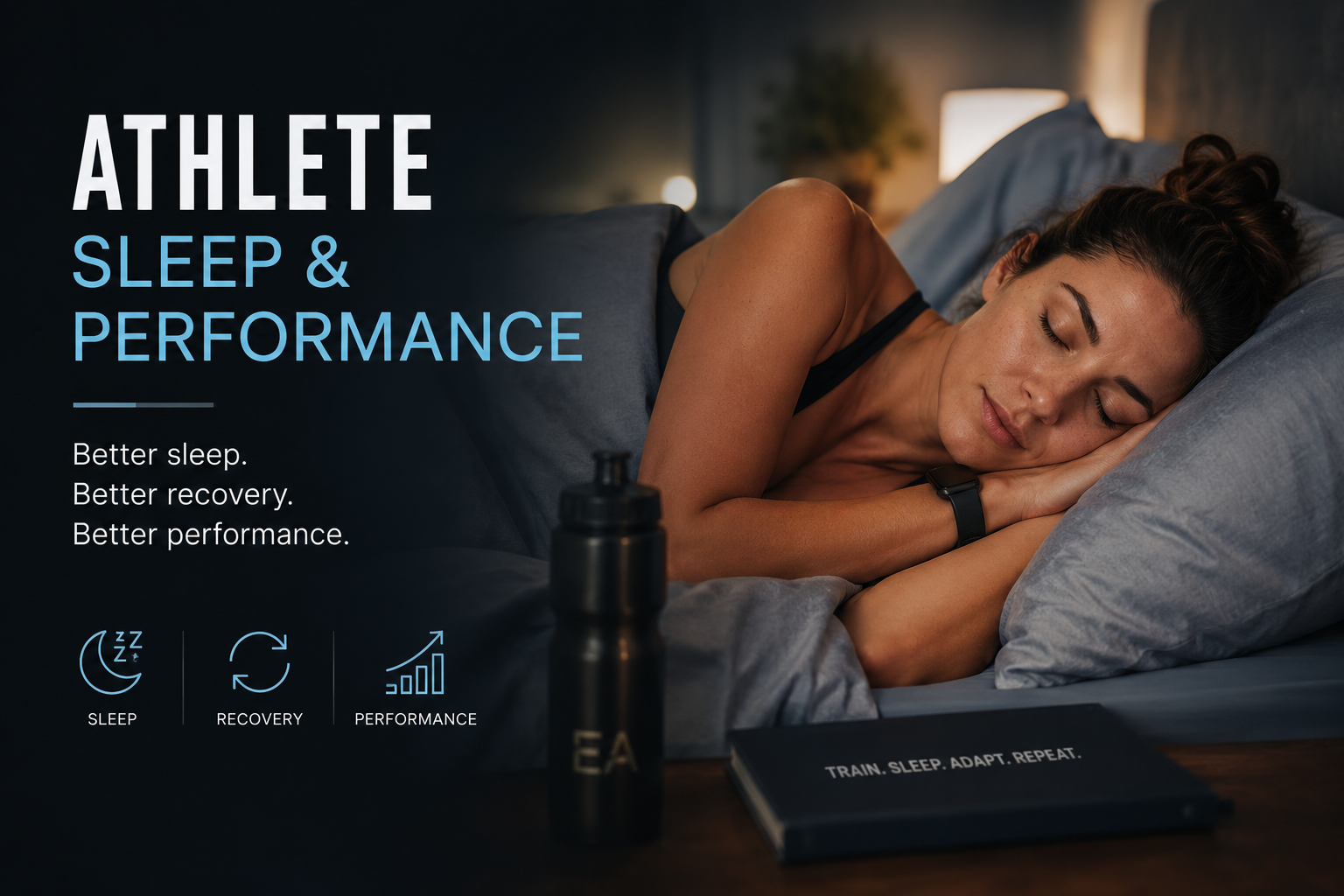
What the Science Says About Sleep, Performance, Recovery and Injury Prevention
Every athlete is chasing an edge. Better programming. Better nutrition. Better recovery tools. There is one recovery tool that is often overlooked, despite being available to every athlete, every night.
Sleep.
In 2020, I was ranked world number one in the 100m and 200m, and number two in the 400m. In 2025, I was ranked world number one in the indoor 60m. Over the years, I learned that performance isn't simply about how hard you train. It's about how well you recover. Sleep became one of my biggest levers in that equation.
A comprehensive review of the research on sleep and athletic performance pulls together exactly why. Sleep isn't passive. It is an active biological process involved in tissue repair, exercise adaptation, hormone regulation, immune function, cognitive processing and injury prevention. In other words, sleep is part of your training.
If you're serious about performance, it deserves to be treated that way.
Why Sleep Is a Performance Variable, Not Just a Recovery One
Researchers describe sleep as a “regenerative window”, a period in which the body carries out many of the processes required to recover and adapt to training. Cut that window short consistently, and you undermine the very adaptations you're training to create.
The effects can be surprisingly large. One night of total sleep deprivation increased cortisol by 21%, reduced testosterone by 24%, and reduced the rate of muscle protein synthesis by 18% in a controlled study of healthy adults. That's one night.
You can train perfectly, eat well and hit your recovery work, but if you repeatedly cut your sleep short, you're making it harder for your body to recover and do the work your training demands.
The Direct Cost to Performance
Sleep loss doesn't just leave you feeling tired. It can directly affect physical performance.
A meta-analysis of 69 studies found that sleep loss reduced athletic performance across strength, endurance, power, speed, high-intensity exercise and skill-based tasks. Performance declined by approximately 0.4% for every additional hour spent awake following sleep loss, with afternoon performance affected more than morning performance.
For an athlete, these small percentages matter. Sprint speed, power output, reaction time, precision, concentration and decision making are all impacted.
When you're racing against a clock, an opponent or your own personal best, there is no room for unnecessary performance loss.
Sleep also plays an important role in learning and motor-skill consolidation. During NREM stage 2, the brain processes and consolidates procedural memories, helping strengthen the motor skills and techniques you've worked on during training.
The work you do on the track, in the gym or on the field doesn't simply stop when training ends. Your brain keeps working on it while you sleep.
Sleep and Recovery: The Hormonal and Immune Story
Sleep drives recovery through a combination of hormonal, neurological and immune processes. Deep N3 sleep is particularly important. This is the stage of sleep dominated by slow delta-wave activity, and it is where the body carries out some of its most important physical recovery processes.
Growth hormone release occurs predominantly during slow-wave delta sleep, with the largest pulse of the night occurring during the first period of deep sleep. Growth hormone plays an important role in tissue repair, protein synthesis and muscle recovery. This is where sleep depth matters.
Research has shown that disrupting slow-wave delta sleep can reduce growth hormone secretion even when total sleep time isn't reduced. In other words, hours in bed aren't the whole story.
You require enough sleep, but the quality and architecture of that sleep matter too.
Sleep also plays an important role in immune regulation and inflammation. Sleep restriction increases inflammatory signalling, while inadequate sleep can weaken immune function and slow the body's recovery from training, injury and illness.
This matters because training itself is a stressor. You deliberately create stress through exercise so your body can adapt. Sleep is where much of the recovery and adaptation work gets done.
How Much Sleep Do Athletes Actually Need?
There isn't one magic number that applies to every athlete. Sleep requirements vary according to the individual, age, sport, training load and circumstances.
Athletes generally need more sleep than the average adult. I can speak from my own experience, particularly during periods of heavy training.
The review recommends approximately 8–10 hours per night for endurance athletes, with similarly high targets across strength and team sports. During intense training periods, sleep needs can increase further.
If you don't get enough sleep at night, a well-timed nap can help. Research reviewed in the paper shows that naps can restore aspects of strength and power following partial sleep restriction, while also improving alertness, cognitive function and reaction speed.
For athletes, the sweet spot is generally an early-afternoon nap rather than a late-afternoon or evening sleep that interferes with the following night.
The goal isn't to use naps to replace proper nighttime sleep. They're a recovery tool when you need one.
Sleep and Injury Prevention
This is the connection that too many training plans miss. Research in young athletes found that those sleeping eight hours or less had a 1.7-fold higher risk of musculoskeletal injury. Poor sleep quality is also common across athletic populations, including elite and youth athletes.
Coaches and athletes obsess over load management, mobility, strength work, warm-ups and recovery protocols. All of these things matter, but sleep sits underneath the entire recovery process.
If you're consistently cutting your sleep short, you're asking your body to repair and adapt without giving it the time and biological environment it requires.
You can have the perfect training program on paper and still be leaving recovery on the table every night.
Sleep, Travel and Competing Across Time Zones
For athletes who travel to compete, sleep becomes even more complicated. Crossing multiple time zones disrupts the body's internal clock, affecting sleep, concentration, mood and physical performance. Eastward travel is generally harder to adapt to because it requires the body clock to shift earlier. The good news is that circadian adaptation can be planned.
- Before travel: gradually shift your sleep and wake times towards the destination time zone.
- On arrival: use light exposure strategically. Morning light is particularly useful when travelling east, while evening light helps when travelling west.
- Protect your sleep: make your sleep environment as dark, cool and quiet as possible, particularly during those first nights in a new time zone.
- Give yourself time to adapt: travel shouldn't simply be treated as something that happens between competitions. It needs to be part of your performance plan.
If travel is part of your season, it deserves the same planning as your taper, nutrition and training schedule.
What Works Against Athletic Sleep?
A handful of everyday habits consistently work against good sleep.
Caffeine late in the day
Caffeine can interfere with sleep, particularly when consumed later in the day. If you're serious about recovery, your afternoon caffeine habit deserves a second look.
Screens and bright light in the evening
Bright light and electronic devices late at night work against the body's natural transition towards sleep.
Inconsistent sleep and wake times
Your body likes rhythm. Going to bed and waking at wildly different times makes it harder to establish a consistent sleep-wake pattern.
Excessive training load and stress
Training hard is part of being an athlete and so is managing the stress that comes with it. Heavy training, competition pressure and travel can all disrupt sleep and make it more difficult to switch off.
None of these things necessarily ruins your sleep on its own. Stack them together, night after night, and they can quietly undermine your recovery and performance.
Understanding the science is one thing. Knowing what to actually do with it is another. We've pulled the key principles from this article into a simple Athlete's Sleep & Recovery Guide you can download and keep.
Inside you'll find practical strategies to help you protect your sleep, support recovery and get more from your training.
Get the Free Athlete's Sleep & Recovery Guide
Enter your name and email and we'll send you the guide, with practical strategies to protect your sleep and get more from your training.
Building an Evidence-Based Sleep Routine
The research brings us back to some remarkably simple fundamentals. Create the conditions for sleep.
- Keep your bedroom cool, dark and quiet
- Aim for consistent sleep and wake times
- Give yourself a proper wind-down period before bed
- Dim the lights in the evening
- Reduce screen exposure before bed
- Avoid caffeine later in the day
- Use short, early-afternoon naps when needed
- Plan sleep and light exposure carefully around travel
- Give yourself enough time in bed to meet your individual sleep needs
None of this is complicated. The challenge is actually doing it consistently. This is something I've experienced personally. In 2025, I had a mild stroke, followed by heart surgery to close a hole in my heart I didn't know I had, along with serious complications from the blood thinners afterwards. I went 3.5 months without training. For someone who has spent most of their life training and competing, that was a very different kind of challenge. Sleep became one of my biggest healing and recovery tools. 10 months later, I'm running 12.8 seconds for the 100m again, the same time I ran the season before everything happened.
Recovery is part of the training.
When the Routine Alone Isn't Enough
What happens when you've done the right things? You've trained hard. You've eaten well. You've turned the screens off. Your bedroom is cool and dark. You're in bed at the right time. Yet you're still lying there with a brain that refuses to switch off. That's frustrating, especially when you know how important sleep is to your performance.
This is where Sleep Soundly comes in. At Earthly Alchemy, we created the Sleep Soundly Delta Soundscape Journey, a six-week program built around six binaural beat soundscapes designed to support your transition into deep, restorative sleep. The journey progresses through three stages:
Ambient Sleep → Deep Sleep → Deep Delta Sleep
Each soundscape is used for one week before moving to the next, creating a structured six-week sleep practice rather than simply pressing play on another random sleep track. Just like training, consistency matters.
You don't build fitness from one workout. You build it through repeated exposure, adaptation and recovery. Sleep deserves the same attention.
If you've already optimised the fundamentals but your brain still needs help making the transition from awake and alert to deep and restored, Sleep Soundly gives you a tool to add to your recovery routine.
Every session you complete is designed to make you better. Training is only part of the equation. You create the stimulus when you train. You create the adaptation when you recover.
Sleep is one of the most powerful recovery tools you have.
Train. Sleep. Adapt. Repeat.
Bank your sleep. Bank on your performance.
Explore the Sleep Soundly Delta Soundscape Journey
Source: Kaczmarek et al., “Sleep and Athletic Performance: A Multidimensional Review of Physiological and Molecular Mechanisms,” Journal of Clinical Medicine, 2025, 14(21), 7606. This article is a narrative review drawing together research across sleep, athletic performance, recovery, injury prevention, circadian rhythms and athlete sleep strategies. Figures and research findings have been paraphrased and restated for this article.
Additional research referenced in this article includes Lamon et al. (2021), which found that one night of total sleep deprivation increased cortisol by 21%, reduced testosterone by 24% and reduced muscle protein synthesis by 18%, and Craven et al. (2022), whose meta-analysis found an approximately 0.4% decline in performance for each additional hour awake following sleep loss.
Keep reading
- You're Training Hard. But Are You Sleeping for Performance?
Sleep is part of your training. Discover what research says about sleep loss, athletic performance and making space for recovery.
- Delta Brainwaves: Where Deep Sleep Meets Recovery
Delta brainwaves sit in the 0.5 to 4 Hz range and dominate the brain's deepest restorative state. Here is what happens in delta sleep, what steals it, and how to protect it.